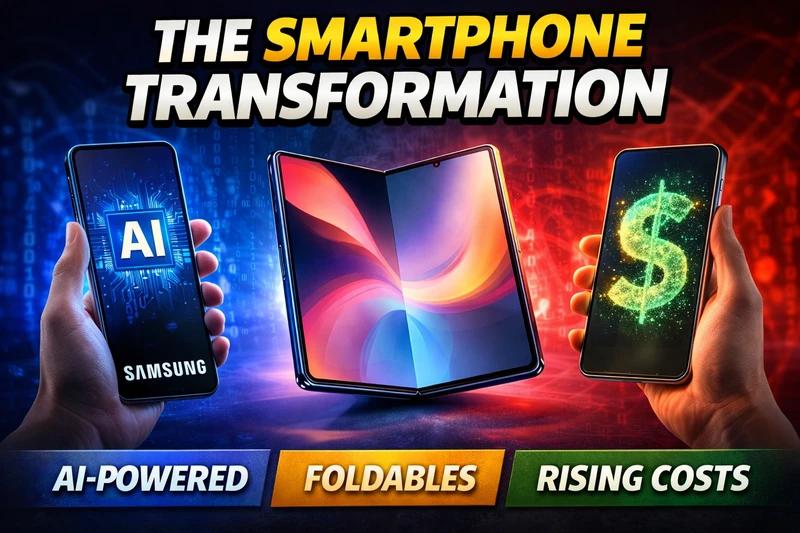
The smartphone you buy in 2026 is not the same device you would have bought two years ago. It is not just faster or has a better camera. The fundamental relationship between you and your phone is changing. Artificial intelligence is no longer a feature you toggle on and off. Foldable screens are no longer experimental curiosities. The economics of owning a phone are shifting in ways that will reshape the entire industry.
This is not hyperbole. When Samsung commits to embedding AI across 800 million devices by the end of 2026, that is not a marketing promise. It is a fundamental rethinking of what a smartphone does. When foldable shipments grow by 30 percent year-over-year according to IDC, that is not a niche trend. It is mainstream adoption happening faster than anyone predicted.
The question is: what does this mean for you? What should you look for when buying a phone this year? And more importantly, what are manufacturers actually delivering versus what they are promising?
The AI Revolution: From Feature to Foundation
For years, smartphone AI has been a collection of neat tricks. Voice assistants that sometimes work. Camera software that recognizes faces. Predictive text that learns your habits. Useful, but not essential. In 2026, that changes.
AI is becoming the operating system. Not the layer on top of Android or iOS, but the intelligence that makes those platforms work. Samsung's strategy makes this clear: the company plans to embed Galaxy AI across its entire lineup, from flagship foldables to entry-level Galaxy A series devices. The goal is 800 million AI-enabled devices by year's end.
The Galaxy S25 Ultra represents Samsung's most advanced AI implementation yet. The device uses on-device AI processing for everything from camera enhancements to real-time translation. The AI can understand context, learn your habits, and adapt to your usage patterns without constantly phoning home to cloud servers.
What does this look like in practice? On-device AI inference means your phone can understand context, translate languages, edit photos, and summarize documents without sending everything to a cloud server. This is not just faster. It is more private, more reliable, and fundamentally different from how phones worked before.
Google's Pixel phones have been leading this charge. The Tensor chips powering Pixel devices are built specifically for on-device AI processing. When you take a photo, the AI analyzes it locally. When you ask a question, the AI processes it on your device first. This is not just a technical improvement. It changes what your phone can do when you are offline, when you are in a country with restricted internet access, or when you simply do not want your data leaving your device.
But there is a darker side to this AI revolution. As AI becomes more powerful and more integrated, the question of how it behaves becomes critical. This is why Anthropic's publication of Claude's constitution in January 2026 matters. It is not just a document about an AI assistant. It is a framework for how AI should make decisions, prioritize values, and handle ethical dilemmas.
The constitution outlines four priorities: safety first, then ethics, then compliance with guidelines, then helpfulness. This hierarchy matters because it means AI should refuse to do harmful things even if you ask it to. It should be honest about uncertainty. It should preserve human autonomy rather than making decisions for you.
For smartphone users, this translates to AI assistants that are more trustworthy but also more constrained. Your phone's AI might refuse to generate certain content, might be more cautious about making recommendations, and might ask for confirmation before taking actions. This is the trade-off: more control and safety, but less autonomy for the AI.
Foldables: From Novelty to Necessity
Foldable phones have been the future for years. The problem is they kept breaking, cost too much, and did not offer enough utility to justify the premium. In 2026, that is changing.
IDC forecasts foldable shipments will grow by 30 percent year-over-year in 2026. This is not incremental growth. This is the category finally reaching the inflection point where it becomes mainstream. Samsung's Galaxy Z TriFold, which unfolds into a 10-inch tablet-like screen, represents the most ambitious foldable design yet. It is not just a phone that folds. It is a device that reimagines what a phone can be. For a deeper dive into how foldables compare, see our comprehensive foldable comparison.
The improvements are real. Hinges are more durable. Screens are more resistant to creasing. Water resistance is becoming standard. Software is finally taking advantage of the larger screens with proper multitasking, better app layouts, and interfaces that adapt to the folded and unfolded states.
But foldables are still expensive. The Galaxy Z TriFold launched at around $2,400 in Korea. Huawei's premium foldables command similar prices. For most consumers, that is still too much. The question is whether mid-range foldables can bridge the gap. Samsung's Galaxy Z Fold FE series and other manufacturers' more affordable options are starting to appear, but they often compromise on durability or features.
The real test for foldables in 2026 is not whether they can match traditional phones on specs. It is whether they can offer enough utility to justify the price. For productivity users, the larger screen is transformative. For media consumers, the tablet-like experience is compelling. For everyone else, the question remains open.
The Price Problem: When "Good Enough" Costs More
Here is the uncomfortable truth about smartphones in 2026: they are getting more expensive, and the reasons are not just inflation. Component costs are rising. Memory prices are up. Supply chain disruptions continue. Research and development for AI and foldable technologies is expensive.
Nothing CEO Carl Pei warned that memory costs could rise by 30 percent in 2026. This is not just affecting premium devices. Mid-range phones are feeling the pressure too. Manufacturers face a choice: raise prices, reduce specs, or find new ways to differentiate.
The result is a market where "good enough" costs more than it used to. A mid-range phone in 2026 might cost what a flagship cost two years ago. A flagship might cost what a foldable cost two years ago. This is not sustainable for most consumers.
But there is a counter-trend: longer device lifespans. Samsung and Google now offer seven years of software support for their flagship devices. Apple has always supported iPhones for five to six years. This means you can keep a phone longer, which changes the economics of upgrading. If you want to understand which phones offer the best long-term support, our comparison of smartphones with extended software support breaks down the commitments from major manufacturers.
The question is whether consumers will adapt. Will people hold onto phones for four or five years instead of upgrading every two? Early data suggests yes, especially among price-sensitive buyers. But this also means manufacturers need to make phones that last, not just phones that are fast.
Apple's approach to longevity is different but equally important. The iPhone 16 series represents Apple's latest commitment to long-term support, with devices that will likely receive iOS updates through 2030 or 2031. Apple's control over both hardware and software allows for better optimization, meaning older iPhones often run new software more smoothly than older Android devices.
Regional Differences: One Market, Many Realities
The smartphone market is not monolithic. What works in the United States does not work in India. What sells in Europe does not sell in China. In 2026, these regional differences are becoming more pronounced.
In the United States, the market is dominated by Apple and Samsung. Premium devices sell well. Foldables are gaining traction but remain niche. AI features are becoming important differentiators. Consumers are willing to pay more for devices that last longer.
In Europe, there is more diversity. Chinese manufacturers like Xiaomi and Oppo have stronger presence. Sustainability and repairability matter more. Right-to-repair legislation is forcing manufacturers to make devices easier to fix. This is changing how phones are designed and supported.
In Asia, especially China and India, the market is different. Price sensitivity is higher. Mid-range devices dominate. Foldables are more popular, especially in China where Huawei and other manufacturers have strong presence. AI features are expected, not premium additions.
In emerging markets, the focus is on value. Devices need to be affordable, durable, and supported for longer periods. This is where manufacturers like Xiaomi, Realme, and Tecno excel. They offer capable devices at lower prices, often with better software support than you might expect.
What This Means for You
If you are buying a phone in 2026, here is what you should know:
For AI features, look for devices with on-device processing. Google Pixel phones lead here, but Samsung's Galaxy AI is also impressive. Apple's Neural Engine is powerful, but Apple is more conservative about AI features. The key is not just having AI, but having AI that works offline and respects your privacy.
For foldables, consider your use case. If you need productivity, a larger foldable like the Galaxy Z Fold makes sense. If you want portability with occasional larger screen use, a clamshell foldable might be better. But be realistic about durability and price. Foldables are still more fragile and expensive than traditional phones.
For longevity, prioritize software support. Samsung and Google offer seven years of updates. Apple offers five to six years. Motorola is promising seven years for its Signature device. This matters more than raw performance if you plan to keep a device for several years. For practical tips on extending your phone's lifespan, check out our guide on maximizing your smartphone's lifespan.
For value, consider mid-range devices with longer support. Samsung's Galaxy A series now gets six years of updates. Google's Pixel A series gets seven years. These devices offer flagship-like software support at much lower prices.
For sustainability, look at repairability. Right-to-repair laws are making it easier to fix phones, but some manufacturers are more supportive than others. Fairphone leads here, but mainstream manufacturers are improving.
The Risks: What Could Go Wrong
Not everything about the 2026 smartphone market is positive. There are real risks:
AI overpromises could backfire. If AI features do not work as advertised, or if they compromise privacy, consumers will lose trust. The industry needs to be honest about what AI can and cannot do.
Foldable durability remains a concern. Even with improvements, foldables are more fragile than traditional phones. A bad experience could set the category back years.
Price increases could push consumers away. If phones become too expensive, people will hold onto devices longer, which reduces upgrade cycles and hurts manufacturers.
Software fragmentation is still a problem. Not all apps work well on foldables. Not all AI features are available on all devices. This creates a confusing experience for consumers.
Privacy concerns are growing. As AI becomes more integrated, the question of what data is collected and how it is used becomes more important. Manufacturers need to be transparent and give users control.
Looking Ahead: What 2027 Might Bring
If 2026 is the year AI and foldables become mainstream, 2027 might be the year they become essential. Apple is reportedly working on its first foldable iPhone, which could launch in late 2026 or early 2027. This would bring foldables to a much larger audience and force other manufacturers to compete more aggressively.
Mid-range phones will likely incorporate more AI features as the technology becomes cheaper to implement. On-device AI processing will become standard, not a premium feature. This will make AI more accessible but also more expected.
Ethical AI frameworks like Anthropic's constitution will likely become industry standards. Consumers will start asking not just what AI can do, but how it makes decisions. This will force manufacturers to be more transparent about their AI systems.
Form factor diversity will continue to grow. We have seen tri-folds, clamshells, and book-style foldables. In 2027, we might see even more experimental designs. The question is which ones will find an audience.
The Bottom Line
The smartphone market in 2026 is not just evolving. It is being redefined. AI is becoming the foundation, not just a feature. Foldables are becoming mainstream, not just experimental. Prices are rising, but so is device longevity. Regional differences are becoming more pronounced.
For consumers, this means more choices but also more complexity. You need to understand what you actually need, not just what sounds impressive. AI features matter, but only if they work well. Foldables are exciting, but only if they are durable and useful. Software support matters more than raw performance if you want a device that lasts.
For manufacturers, this means balancing innovation with affordability, AI capabilities with privacy, and new form factors with reliability. The companies that get this right will thrive. The companies that do not will struggle.
The smartphone market in 2026 is not the same as it was in 2024. It is more interesting, more complex, and more important. The device in your pocket is no longer just a phone. It is becoming something else entirely. And that is both exciting and a little bit scary.