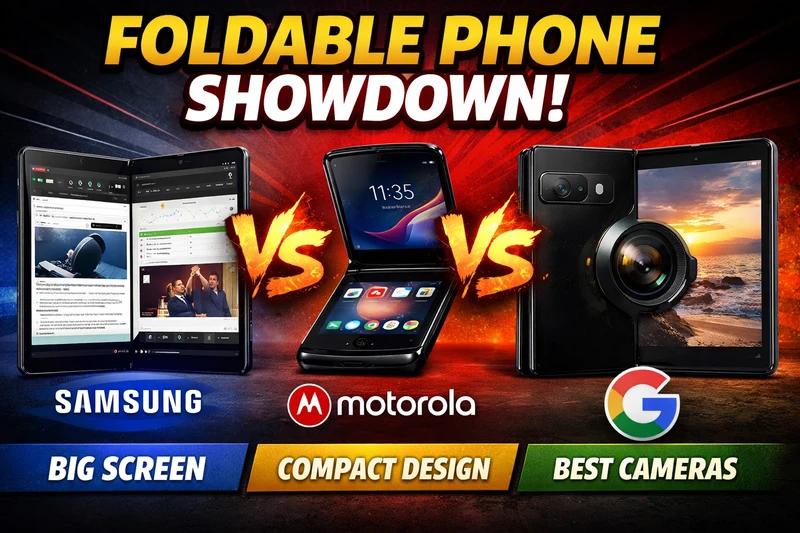
The foldable phone market has finally matured. What started as expensive experiments with fragile screens and visible creases has evolved into a legitimate category with devices that people actually want to use every day. Samsung has refined its Galaxy Z Fold line through six generations. Motorola brought back the Razr name with a modern twist. Google entered the foldable space with the Pixel Fold, and now we are seeing its second iteration.
But here is the thing: these are not just different phones. They represent fundamentally different approaches to what a foldable should be. Samsung thinks you want a tablet that folds into a phone. Motorola thinks you want a phone that unfolds into something bigger. Google thinks you want something in between, with the best cameras possible.
This is not just about specs. It is about which philosophy matches how you actually use your phone. Do you need a massive screen for productivity? Do you want something that fits in your pocket without feeling like a brick? Do you prioritize camera quality above all else?
We are comparing three of the most significant foldable phones available right now: the Samsung Galaxy Z Fold 6, the Motorola Razr Fold, and the Google Pixel Fold 2. Each represents a different take on the foldable concept, and each has strengths that make it the right choice for different people.
The Three Philosophies
Before we dive into the specifics, it is worth understanding what each company is trying to achieve with these devices.
Samsung's Galaxy Z Fold 6 is the tablet-first approach. When unfolded, you get a 7.6-inch screen that feels like a small tablet. When folded, you get a 6.3-inch cover screen that is narrow but usable. The idea is that you do most of your work on the big screen, and the cover screen is for quick tasks. This works if you are someone who needs to read documents, edit spreadsheets, or watch videos on a larger display.
Motorola's Razr Fold takes the opposite approach. It is a phone-first device that happens to unfold. The cover screen is a full 6.9 inches, which means you can use it like a regular phone most of the time. When you need more space, you unfold it to reveal an 8.0-inch inner display. This design makes more sense if you want a foldable but do not want to compromise on the phone experience.
Google's Pixel Fold 2 sits somewhere in the middle. It has a 5.8-inch cover screen that is wider than Samsung's but smaller than Motorola's. The inner display is 7.6 inches, similar to Samsung's. But Google's real focus is on the camera system and software experience. This is the foldable for people who want great photos and a clean Android experience.
Loading comparison...
Design and Build Quality
All three phones feel premium, but they achieve that feeling in different ways.
The Galaxy Z Fold 6 is the most refined version of Samsung's foldable design yet. It is thinner when folded than previous models, and the hinge feels smoother. The phone uses Samsung's Armor Aluminum frame and Gorilla Glass Victus 2 on both displays. It feels substantial without being heavy, though at 239 grams, it is not light. The narrow cover screen takes some getting used to, but Samsung has optimized the software to make it more usable than before.
Motorola's Razr Fold feels different in the hand. The phone is wider and shorter when folded, which makes it feel more like a traditional smartphone. The build quality is excellent, with an aluminum frame and Gorilla Glass Victus 2 protection. At 229 grams, it is slightly lighter than Samsung's offering. The hinge mechanism feels solid, and Motorola has done a good job minimizing the crease on the inner display.
The Pixel Fold 2 follows Google's design language: clean, minimal, and functional. It uses an aluminum frame with Gorilla Glass protection. At 250 grams, it is the heaviest of the three, but the weight distribution feels balanced. The cover screen is wider than Samsung's, making it more comfortable for one-handed use. Google has also improved the hinge mechanism, making it smoother and more durable.
When it comes to durability, all three phones have IPX8 water resistance ratings, which means they can survive being submerged in water. However, none of them are dust-resistant, which is a limitation of the foldable form factor. The hinges are the most vulnerable parts, and all three manufacturers have improved them over previous generations.
Display Quality
The displays are where these phones really differentiate themselves, and the differences are significant.
Samsung's Galaxy Z Fold 6 uses Dynamic AMOLED 2X panels for both screens. The inner display is 7.6 inches with a 2176 x 1812 resolution and a 120Hz refresh rate. The cover screen is 6.3 inches with a 2376 x 968 resolution and also supports 120Hz. Both displays are bright, color-accurate, and smooth. Samsung's expertise in display technology shows here. The crease is still visible when the screen is off, but it is less noticeable during use than on previous models.
Motorola's Razr Fold uses pOLED displays. The inner display is 8.0 inches with a 2400 x 2200 resolution and a 165Hz refresh rate, which is the highest of the three. The cover screen is 6.9 inches with a 2640 x 1080 resolution and a 144Hz refresh rate. Both displays are bright and vibrant, and the high refresh rates make scrolling feel incredibly smooth. The crease is well-hidden, and Motorola has done an excellent job with the display calibration.
Google's Pixel Fold 2 uses LTPO OLED displays for both screens. The inner display is 7.6 inches with a 2208 x 1840 resolution and a 120Hz refresh rate. The cover screen is 5.8 inches with a 2092 x 1080 resolution and also supports 120Hz. Google has tuned these displays for accuracy rather than vibrancy, which makes them excellent for photo editing and viewing. The crease is present but not distracting.
All three phones support HDR10+ content, and they all get bright enough for outdoor use. Samsung's displays are the brightest, followed by Motorola, then Google. But the differences are minor, and all three are perfectly usable in direct sunlight.
Performance and Software
All three phones use Qualcomm's Snapdragon 8 Gen 3 chipset, which is the current flagship processor. This means performance is excellent across the board. Apps launch quickly, multitasking is smooth, and gaming performance is top-tier. The differences come down to software optimization and how each manufacturer handles the foldable form factor.
Samsung's One UI 6.1 is the most mature foldable software experience. It has features like App Continuity, which automatically moves apps from the cover screen to the inner display when you unfold. The taskbar makes it easy to switch between apps, and Samsung's Multi-Window implementation is excellent. Samsung also commits to seven years of OS and security updates, which is the longest in the industry.
Motorola's software is closer to stock Android, which some people prefer. It is clean and fast, with minimal bloatware. Motorola has added some foldable-specific features, like Flex Mode for using the phone partially folded, but the software is not as polished as Samsung's. Motorola commits to four years of OS updates and five years of security updates, which is good but not as impressive as Samsung's commitment.
Google's Pixel software is, unsurprisingly, the cleanest Android experience. It is fast, intuitive, and free of bloatware. Google has optimized Android for foldables, and the Pixel Fold 2 benefits from those optimizations. Features like split-screen multitasking work seamlessly, and Google's Material You theming adapts well to the larger screen. Google commits to seven years of OS and security updates, matching Samsung's commitment.
When it comes to performance, all three phones handle everyday tasks with ease. The Snapdragon 8 Gen 3 is powerful enough that you will not notice performance differences in normal use. The differences show up in sustained performance, where Samsung's vapor chamber cooling system gives it a slight edge during extended gaming sessions.
Camera Systems
This is where the three phones diverge significantly, and it is one of the most important differentiators.
Samsung's Galaxy Z Fold 6 has a capable camera system, but it is not the company's best. The main camera is 50 megapixels with optical image stabilization. There is a 12-megapixel ultra-wide camera and a 10-megapixel telephoto camera with 3x optical zoom. The cover screen has a 10-megapixel selfie camera, and the inner display has a 4-megapixel under-display camera. The cameras are good, but they are not as good as what you get on the Galaxy S25 Ultra. Photos are sharp and well-exposed, but they lack the character and processing that make Samsung's flagship cameras special.
Motorola's Razr Fold has a similar camera setup to Samsung's. The main camera is 50 megapixels, there is a 13-megapixel ultra-wide camera, and a 10-megapixel telephoto camera with 3x optical zoom. The cover screen has a 32-megapixel selfie camera, and the inner display has a 20-megapixel under-display camera. The cameras are solid, but they are not exceptional. Motorola has improved its image processing, but it still lags behind Samsung and Google in terms of overall camera quality.
Google's Pixel Fold 2 has the best camera system of the three. It uses the same camera sensors as the Pixel 9 Pro, which means you get Google's excellent computational photography. The main camera is 50 megapixels with Google's advanced image processing. There is a 48-megapixel ultra-wide camera and a 48-megapixel telephoto camera with 5x optical zoom. The cover screen has a 10.5-megapixel selfie camera, and the inner display has an 8-megapixel under-display camera. Google's Night Sight, Portrait Mode, and Magic Eraser features all work on the Fold 2, and the results are consistently excellent. If camera quality is your top priority, the Pixel Fold 2 is the clear winner.
Battery Life and Charging
Battery life is crucial for foldables because the larger displays consume more power. All three phones have different battery capacities and charging speeds.
Samsung's Galaxy Z Fold 6 has a 4,400 mAh battery. In our testing, it lasted about 8 hours of screen-on time with the inner display, or about 12 hours with just the cover screen. The phone supports 25W wired charging and 15W wireless charging. It takes about 70 minutes to charge from empty to full with a compatible charger.
Motorola's Razr Fold has a 4,200 mAh battery. It lasted about 7.5 hours of screen-on time with the inner display, or about 11 hours with just the cover screen. The phone supports 68W wired charging and 15W wireless charging. It takes about 45 minutes to charge from empty to full, which is significantly faster than Samsung's offering.
Google's Pixel Fold 2 has a 4,827 mAh battery, which is the largest of the three. It lasted about 9 hours of screen-on time with the inner display, or about 13 hours with just the cover screen. The phone supports 30W wired charging and 23W wireless charging. It takes about 60 minutes to charge from empty to full.
If battery life is your top priority, the Pixel Fold 2 offers the best endurance. If fast charging matters more, Motorola's 68W charging is impressive. Samsung's battery life is solid, but the slower charging speed is a drawback.
Price and Value
Foldables are expensive, and these three phones are no exception. But the value proposition differs for each.
Samsung's Galaxy Z Fold 6 starts at $1,799 for the base model with 256GB of storage. The 512GB model costs $1,919, and the 1TB model costs $2,159. This is expensive, but you are getting Samsung's most refined foldable experience, excellent software support, and a mature ecosystem of accessories.
Motorola's Razr Fold starts at $999 for the base model with 256GB of storage. The 512GB model costs $1,099. This is significantly cheaper than Samsung's offering, and it represents excellent value for what you get. The phone is well-built, has great displays, and offers a unique take on the foldable form factor.
Google's Pixel Fold 2 starts at $1,799 for the base model with 256GB of storage. The 512GB model costs $1,919. This matches Samsung's pricing, but you are paying for the best camera system and the cleanest software experience. Whether that is worth the premium depends on how much you value photography.
If price is your primary concern, Motorola's Razr Fold is the clear winner. It offers 80 percent of the experience for 55 percent of the price. If you want the best overall experience and do not mind paying a premium, Samsung's Galaxy Z Fold 6 is the better choice. If camera quality is your top priority, Google's Pixel Fold 2 is worth the investment.
Who Should Buy Which?
The best foldable for you depends on what you prioritize.
Buy the Samsung Galaxy Z Fold 6 if:
- You want the most mature foldable software experience
- You need a tablet-sized screen for productivity
- You value long-term software support (seven years of updates)
- You are already invested in the Samsung ecosystem
- You do not mind the narrow cover screen
Buy the Motorola Razr Fold if:
- You want a foldable that feels like a regular phone
- You prioritize value and do not want to spend $1,800
- You prefer a wider cover screen for one-handed use
- You want the fastest charging speeds
- You do not need the absolute best cameras
Buy the Google Pixel Fold 2 if:
- Camera quality is your top priority
- You want the cleanest Android experience
- You value Google's computational photography features
- You want long-term software support (seven years of updates)
- You do not mind paying a premium for the best cameras
The Bottom Line
There is no single "best" foldable phone. Each of these three devices represents a different philosophy, and each excels in different areas.
Samsung's Galaxy Z Fold 6 is the most refined and feature-complete option. It has the best software, the longest update commitment, and the most mature ecosystem. But it is expensive, and the narrow cover screen takes getting used to.
Motorola's Razr Fold is the best value proposition. It offers a unique phone-first approach at a significantly lower price point. The cameras are not as good as the competition, but everything else is solid.
Google's Pixel Fold 2 has the best cameras and the cleanest software. If photography is important to you, this is the foldable to get. But it is expensive, and the software is not as feature-rich as Samsung's.
The foldable market has matured to the point where you can choose based on your priorities rather than just accepting whatever is available. These three phones prove that there is more than one way to make a great foldable, and that is good news for everyone.