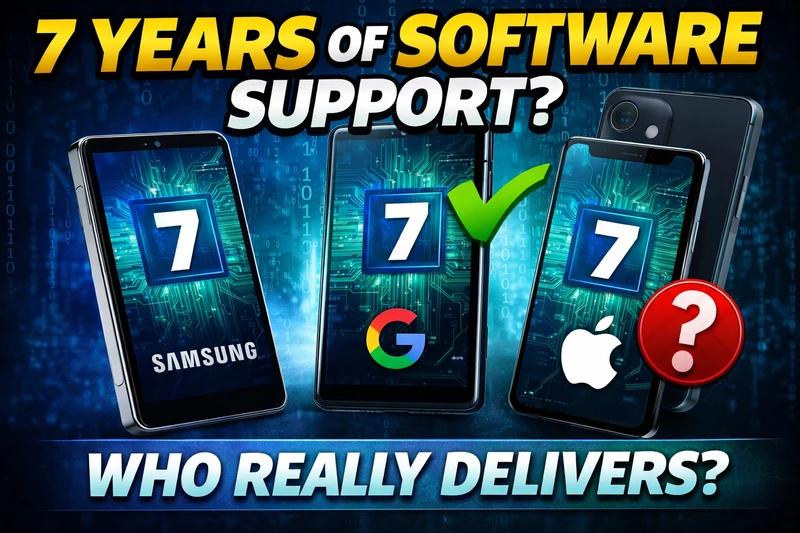
When you spend $1,000 or more on a smartphone, you are not just buying hardware. You are buying into a promise. The promise that your device will receive security patches when vulnerabilities are discovered. The promise that new features will arrive over time. The promise that your phone will not become obsolete in two years.
For most of the smartphone era, that promise was weak. Manufacturers would support devices for two or three years, then move on. But something has changed. In 2025, we are seeing manufacturers commit to five, six, even seven years of software support. This is not just marketing. It is a fundamental shift in how companies think about device longevity.
The question is: which manufacturers are actually delivering on these promises? And more importantly, which phones should you buy if you want a device that will last?
What Extended Support Actually Means
Before we compare devices, it is worth understanding what extended software support entails. There are three types of updates that matter:
Major OS updates bring new Android or iOS versions with new features, interface changes, and platform improvements. These are the big updates that change how your phone works.
Security patches fix vulnerabilities and bugs without changing the operating system version. These are critical for keeping your device safe, but they do not add new features.
Feature drops are smaller updates that add new capabilities without a full OS upgrade. Google's Pixel Feature Drops are the best example, but other manufacturers are starting to offer similar programs.
The gold standard is a commitment to both OS updates and security patches for an extended period. Getting security patches without OS updates keeps you safe but leaves you behind on features. Getting OS updates without security patches is rare, but it would leave you vulnerable.
The Current Leaders
As of 2025, four manufacturers stand out for their extended support commitments: Samsung, Google, Motorola, and Apple. Each takes a different approach, and each has strengths and weaknesses.
Samsung has made the most aggressive commitment. Starting with the Galaxy S24 series, Samsung guarantees seven years of both OS updates and security patches for its flagship devices. This includes the Galaxy S series, Z Fold and Z Flip series, and certain Galaxy Tab models. Samsung has also extended this commitment to some mid-range devices, with the Galaxy A series receiving six years of support.
Google matches Samsung's seven-year commitment for its Pixel 8 and Pixel 9 series. Google's approach is slightly different: it emphasizes timely updates and regular Feature Drops that add new capabilities throughout the device's lifespan. Google also has a strong track record of delivering updates quickly, often beating Samsung to the punch.
Motorola has made significant improvements. The Motorola Signature, launched in 2025, comes with a seven-year update commitment. This is a major shift for Motorola, which historically struggled with update support. The question is whether Motorola can maintain this commitment across its broader lineup.
Apple does not make explicit year-based commitments, but it has the longest track record of supporting devices. Recent iPhones typically receive five to six years of major iOS updates, with security updates often continuing beyond that. Apple's approach is different because it controls both hardware and software, which allows for better optimization and longer support periods.
Samsung: The Seven-Year Standard
Samsung's commitment to seven years of updates is the most comprehensive in the Android world. The Galaxy S24 series, launched in early 2024, will receive updates through 2031. The Galaxy S25 series, launched in 2025, extends that commitment through 2032.
What makes Samsung's commitment impressive is its scope. This is not just for one or two flagship models. It covers the entire Galaxy S series, the Z Fold and Z Flip foldables, and certain Galaxy Tab tablets. Samsung has also extended six years of support to mid-range devices like the Galaxy A26, A36, and A56.
Samsung's One UI software helps here. It is mature, feature-rich, and optimized for Samsung's hardware. The company has invested heavily in making sure older devices can run newer software versions smoothly. This is not always perfect—some older devices do slow down with major updates—but Samsung's track record is generally good.
The challenge for Samsung is consistency. While the company has committed to seven years for new devices, older devices that launched before this policy may not receive the same treatment. If you buy a Galaxy S23 today, you will not get seven years of updates. You will get what Samsung promised at launch, which is typically four years of OS updates and five years of security patches.
Google: Timely Updates and Feature Drops
Google's Pixel phones have always been about software. The company uses them as showcases for the latest Android features, and that philosophy extends to update support. The Pixel 8 and Pixel 9 series come with seven years of OS and security updates, matching Samsung's commitment.
What sets Google apart is speed. Pixel devices typically receive updates faster than any other Android manufacturer. When Google releases a new Android version, Pixel phones get it first. When security patches are released, Pixel phones get them within days, not weeks or months.
Google also has its Feature Drop program, which adds new capabilities to Pixel phones throughout their lifespan. These are not just bug fixes or security patches. They are genuine new features: improved camera capabilities, new AI-powered tools, enhanced privacy controls. This means that even after your Pixel stops receiving major OS updates, it may still get new features through Feature Drops.
The Pixel 9 series, launched in 2024, will receive updates through 2031. The Pixel 8 series, launched in 2023, will receive updates through 2030. Google has also extended this commitment to the Pixel 8a, making it one of the few mid-range devices with seven years of support.
Google's challenge is hardware. Pixel phones are not always the most powerful devices, and some users report that older Pixels struggle with performance after several years of updates. This is less of an issue with recent models, which use more powerful chips, but it is worth considering if you plan to keep a device for the full seven years.
Motorola: The Surprise Contender
Motorola's update history has been inconsistent. The company has struggled to deliver timely updates, and its update commitments have often been shorter than competitors. But Motorola is trying to change that.
The Motorola Signature, launched in 2025, comes with a seven-year update commitment. This is Motorola's flagship device, and it represents a significant investment in long-term support. The question is whether this is a one-off commitment for a premium device or the start of a broader policy change.
Motorola's software is closer to stock Android than Samsung's One UI, which some users prefer. It is clean, fast, and relatively free of bloatware. But Motorola has historically been slower to deliver updates than Samsung or Google, and the company's track record with mid-range devices is weaker.
If Motorola can maintain its seven-year commitment for the Signature and extend similar support to other devices, it could become a serious contender in the longevity space. But the company needs to prove it can deliver consistently, not just make promises.
Apple: The Established Leader
Apple does not make explicit year-based commitments, but it has the longest and most consistent track record of supporting devices. Recent iPhones typically receive five to six years of major iOS updates, with security updates often continuing for longer.
The iPhone 11, launched in 2019, received iOS 18 in 2024, which is five years of major updates. The iPhone 12, launched in 2020, will likely receive iOS 19 in 2025, extending its support to five years as well. Apple's track record suggests that newer iPhones will receive similar or better support.
What makes Apple's approach different is integration. Because Apple controls both hardware and software, it can optimize updates for older devices more effectively. An iPhone from 2020 can run the latest iOS version more smoothly than an Android phone from the same year can run the latest Android version.
Apple also has a strong track record with security updates. Even after devices stop receiving major iOS updates, Apple often continues to release security patches for critical vulnerabilities. This is not guaranteed, but it is common.
The challenge with Apple is that the company does not make explicit commitments. You do not know exactly how long your iPhone will be supported until Apple stops supporting it. This makes it harder to plan, but Apple's historical track record is strong enough that most users feel confident buying an iPhone with the expectation of long-term support.
What This Means for You
If you are buying a phone in 2025 and want it to last, here is what you should know:
For maximum support duration, buy a Samsung Galaxy S24 or S25 series device, or a Google Pixel 8 or Pixel 9 series device. Both offer seven years of updates, which is the longest commitment in the Android world.
For the fastest updates, choose a Google Pixel. Google delivers updates faster than any other Android manufacturer, and the Feature Drop program adds value throughout the device's lifespan.
For the most consistent track record, choose an iPhone. Apple does not make explicit commitments, but its historical support is the longest and most reliable in the industry.
For the best value, consider Samsung's mid-range devices. The Galaxy A series now receives six years of support, which is excellent for devices that cost significantly less than flagships.
For sustainability and repairability, consider devices from companies like Fairphone, which offer long support periods along with modular, repairable designs. These devices are less powerful than flagships, but they are built to last and be repaired.
The Reality Check
Extended software support is not a magic solution. Even with seven years of updates, your phone will face challenges:
Hardware limitations will eventually become an issue. Newer software features may require more powerful processors, better cameras, or new sensors that older devices do not have. You may receive updates, but you may not get all the features.
Performance degradation is real. Even with software updates, older devices will struggle with newer, more demanding apps and features. A phone from 2025 may run smoothly in 2030, but it will not run as smoothly as a phone from 2030.
Battery degradation is inevitable. Lithium-ion batteries lose capacity over time, and after five or six years, you may need a battery replacement to maintain reasonable battery life.
Repairability matters. A phone with seven years of software support is useless if you cannot repair it when the screen breaks or the battery dies. Consider devices with good repairability scores and available parts.
The Bottom Line
Extended software support is no longer a niche feature. It is becoming standard for flagship devices, and it is spreading to mid-range devices as well. Samsung and Google are leading the way with seven-year commitments, while Apple continues to offer strong support through its integrated approach.
If you are buying a phone today and want it to last, prioritize devices with explicit, long-term update commitments. Samsung's Galaxy S24 and S25 series, Google's Pixel 8 and Pixel 9 series, and Apple's recent iPhones are all excellent choices.
But remember: software support is just one part of device longevity. You also need to consider hardware quality, repairability, and your own usage patterns. A phone with seven years of software support is valuable, but it is not valuable if the hardware fails or becomes unusable due to performance issues.
The smartphone industry is finally taking longevity seriously. That is good news for consumers, good news for the environment, and good news for anyone who wants to get more value from their devices. The question is not whether extended support matters—it clearly does—but which manufacturer will deliver on their promises most consistently over the next several years.
Loading comparison...