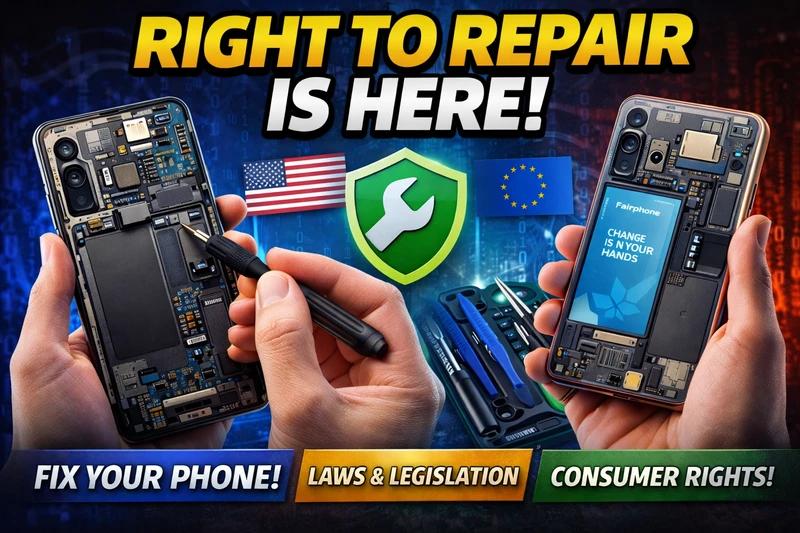
Right to Repair Goes Mainstream: How New Laws Are Changing Smartphone Ownership
Explore how right-to-repair legislation in the US and EU is reshaping smartphone ownership. Learn which manufacturers are adapting, what consumers can now do, and how this movement affects device longevity and sustainability.
When your phone breaks, you should be able to fix it. That seems obvious, but for years it has not been that simple. Manufacturers have made it difficult, sometimes impossible, to repair devices yourself or take them to independent repair shops. Proprietary screws, locked software, parts pairing that rejects third-party components—these are not accidents. They are deliberate choices designed to keep you coming back to the manufacturer.
But something is changing. Right-to-repair legislation is gaining momentum across the United States and Europe. Laws are being passed. Lawsuits are being filed. Manufacturers are starting to respond. In 2026, the right to repair is no longer a niche issue. It is becoming mainstream policy.
This matters because it affects how long your phone lasts, how much it costs to maintain, and what happens to it when you are done with it. It affects the environment. It affects your wallet. And it affects whether you actually own the device you paid for, or whether you are just renting it until the manufacturer decides it is time for an upgrade.
What Right to Repair Actually Means
Right to repair is not about forcing manufacturers to give away trade secrets. It is about giving consumers and independent repair shops access to the parts, tools, documentation, and software they need to fix devices. It is about making repair possible, affordable, and legal.
Think about it this way: when you buy a car, you can take it to any mechanic. You can buy parts from third-party suppliers. You can fix it yourself if you know how. The manufacturer does not lock you into their service centers. Right to repair wants the same thing for electronics: phones, laptops, tablets, and other devices.
The problem is that modern smartphones are more like computers than simple devices. They run complex software. They have security features. They use proprietary components. Manufacturers argue that opening these up could compromise security, void warranties, or create safety risks. There is some truth to these concerns, but they are also convenient excuses for maintaining control over the repair ecosystem.
The Legislative Landscape: Where Laws Stand in 2026
The right-to-repair movement has been building for years, but 2026 is when it starts to feel real. In the United States, multiple states have passed laws, and more are considering them. The European Union has implemented comprehensive right-to-repair regulations that are reshaping how manufacturers operate globally.
Oregon's Right to Repair Act, which took effect in January 2025, is one of the strongest laws in the country. It bans parts pairing, the practice of locking replacement parts to proprietary software checks. If you replace your iPhone's screen with a third-party part, the phone should still work. Oregon's law says manufacturers cannot disable features or show warning messages just because you used a non-OEM part.
Colorado passed similar legislation in 2024 that takes effect in 2026. The law requires manufacturers to provide parts, tools, and documentation for consumer electronics. It covers phones, laptops, tablets, and other devices. Washington state has also passed right-to-repair laws, with special protections for accessibility devices like wheelchairs.
At the federal level, the Fair Repair Act has been introduced in Congress, though it has not yet passed. The REPAIR Act focuses specifically on vehicles, requiring automakers to provide diagnostic data and tools. These federal bills face opposition from manufacturers, but the fact that they exist and have bipartisan support shows how mainstream the issue has become.
In Europe, the situation is more advanced. The EU's right-to-repair regulations require manufacturers to provide repair information and spare parts for up to 10 years after a product is discontinued. This applies to smartphones, tablets, and other electronics. The regulations also require manufacturers to design products that are easier to repair, with modular components and standardized parts where possible.
How Manufacturers Are Responding
Manufacturers are not happy about these laws, but they are adapting. Some are doing the minimum required. Others are going further, seeing repairability as a competitive advantage.
Apple has been one of the most resistant companies to right-to-repair legislation. The company has argued that third-party repairs could compromise security and safety. But Apple is also making changes. The company now offers self-service repair programs in some regions, allowing customers to buy genuine parts and tools. The program is limited and expensive, but it is a start. Apple also provides repair manuals for some devices, though they are often incomplete or difficult to use.
Device ID: 50c7e458-ba40-474e-8e6d-4fdb8abe4921
Samsung has taken a different approach. The company has partnered with repair shops through its Samsung Care program, providing authorized repair services while also making some parts available to independent shops. Samsung's approach is more open than Apple's, but it still maintains significant control over the repair ecosystem. The company has also started designing some devices with repairability in mind, though this is not consistent across all product lines.
Google has been relatively supportive of right-to-repair initiatives. The company provides repair guides for Pixel devices and has made some parts available to independent repair shops. Google's Pixel phones are generally easier to repair than many competitors, though they are still not as repairable as they could be. The company has also committed to providing longer software support, which reduces the need for repairs in some cases.
Motorola has been less vocal about right-to-repair, but the company has made some efforts to improve repairability. Motorola's devices are generally easier to open and repair than many competitors, though parts availability can still be an issue. The company's commitment to seven years of software support for devices like the Signature helps extend device lifespans, reducing the need for repairs.
Then there is Fairphone, which has built its entire business model around repairability. The Fairphone 6 is designed to be easily disassembled, with modular components that can be replaced individually. The company provides repair guides, sells spare parts directly to consumers, and designs devices specifically for longevity. Fairphone is proof that repairability and modern smartphone features are not mutually exclusive.
Device ID: 9692ea81-63bd-4821-ad3e-778157eedf7f
What Consumers Can Do Now
Right-to-repair laws are changing what is possible, but consumers still need to be proactive. Here is what you can do:
Choose repairable devices. When buying a phone, consider how easy it is to repair. Look for devices with replaceable batteries, modular designs, and available spare parts. Fairphone leads here, but other manufacturers are improving. Check repair guides on sites like iFixit to see how repairable a device is before you buy.
Support independent repair shops. When your device breaks, consider taking it to an independent repair shop instead of the manufacturer. These shops often charge less and can get the job done faster. Right-to-repair laws are making it easier for them to get parts and tools, so they can offer better service.
Learn basic repairs. Some repairs are simple: replacing a screen protector, cleaning charging ports, replacing batteries on devices that allow it. Learning these basic skills can save you money and extend your device's life. Just make sure you know what you are doing and have the right tools.
Advocate for better laws. If your state does not have right-to-repair laws, contact your representatives. The movement has gained momentum because consumers have demanded it. Your voice matters.
Consider device longevity. Right-to-repair is part of a larger movement toward device longevity. When buying a phone, consider how long it will be supported with software updates. A device with seven years of support is more valuable than one with three years, even if the initial price is higher. For more on this, see our comparison of smartphones with extended software support.
The Environmental Impact
Right-to-repair is not just about consumer rights. It is also about the environment. Electronic waste is a growing problem. Millions of phones are discarded every year, many of them still functional or easily repairable. Making devices easier to repair means fewer devices end up in landfills.
When you can repair a phone instead of replacing it, you reduce the environmental impact of manufacturing. Producing a new smartphone requires mining rare earth metals, manufacturing components, and shipping products around the world. All of this has a carbon footprint. Repairing a device uses far fewer resources.
The EU's right-to-repair regulations explicitly link repairability to environmental goals. The regulations are part of the EU's circular economy strategy, which aims to reduce waste and extend product lifespans. This is not just good for consumers. It is good for the planet.
But there is a nuance here. Some research suggests that right-to-repair laws might have unintended consequences. If devices last longer, people might keep energy-inefficient older devices instead of upgrading to more efficient new ones. This is a valid concern, but it does not outweigh the benefits of reducing e-waste and extending device lifespans.
The Challenges Ahead
Right-to-repair laws are not a panacea. They face several challenges:
Enforcement is difficult. Laws exist on paper, but manufacturers can find ways around them. They might provide parts but make them prohibitively expensive. They might provide documentation but make it incomprehensible. They might comply with the letter of the law while violating its spirit.
Parts availability remains an issue. Even with right-to-repair laws, getting genuine parts can be difficult. Manufacturers might limit parts to authorized repair shops. They might stop producing parts for older devices. They might use proprietary connectors or designs that make third-party parts impossible.
Software locks persist. Parts pairing is being banned in some states, but manufacturers can still use software to restrict repairs. They might require proprietary diagnostic tools. They might lock certain features behind software checks. They might void warranties for using third-party parts, even if the law says they cannot.
Safety and security concerns are real. Opening up devices for repair does create some security and safety risks. Malicious actors could install compromised components. Inexperienced repairers could damage devices or create safety hazards. These concerns are legitimate, but they should not be used as excuses to prevent all third-party repairs.
The industry is fighting back. Manufacturers have lobbied against right-to-repair laws. They have filed lawsuits. They have argued that these laws compromise security, safety, and intellectual property. The fight is not over, and manufacturers will continue to resist.
What This Means for the Future
Right-to-repair is here to stay. The laws are being passed. The movement is gaining momentum. Manufacturers are adapting, some willingly and some reluctantly. But the real test will be whether these laws actually change how devices are designed and repaired.
The ideal outcome is a world where devices are designed for repair from the start. Modular components. Standardized parts. Easy disassembly. Available documentation. This is not impossible. Fairphone proves it. Other manufacturers are starting to follow.
But we are not there yet. Most devices are still difficult to repair. Parts are still hard to get. Documentation is still incomplete. Right-to-repair laws are a step in the right direction, but they are just the beginning.
For consumers, this means more options. You can repair your device yourself, take it to an independent shop, or go to the manufacturer. You have choices. But you also need to be informed. Know your rights. Know what your device can and cannot do. Know what repairs are possible and what are not.
For manufacturers, this means adapting to a new reality. The old model of locking down devices and controlling the repair ecosystem is ending. Companies that embrace repairability will have a competitive advantage. Companies that resist will face legal challenges and consumer backlash.
For the environment, this means less waste. Fewer devices in landfills. Fewer resources consumed. A more sustainable approach to electronics. This is not just good for the planet. It is necessary.
The Bottom Line
Right-to-repair is no longer a niche issue. It is becoming mainstream policy, and it is changing how smartphones are designed, sold, and maintained. Laws are being passed. Manufacturers are adapting. Consumers are gaining more control over their devices.
But the movement is still young. Enforcement is a challenge. Parts availability is improving but not perfect. Software locks persist. The industry is fighting back. There is still work to be done.
The question is not whether right-to-repair will succeed. It already is. The question is how far it will go, and how quickly. Will manufacturers fully embrace repairability? Will laws be strong enough to make a real difference? Will consumers take advantage of their new rights?
The answers to these questions will shape the smartphone industry for years to come. They will determine how long devices last, how much they cost to maintain, and what happens to them when they break. They will determine whether you actually own your phone, or whether you are just renting it.
Right-to-repair is about ownership. It is about control. It is about sustainability. And in 2026, it is finally going mainstream. If you want to learn more about extending your device's lifespan through proper care and maintenance, check out our guide on maximizing your smartphone's lifespan.
Tags:
right to repair smartphones
phone repair laws
smartphone repairability
right to repair 2026
phone parts availability
sustainable phones
phone repair guide
Share:
Frequently Asked Questions
Right to repair is a legal framework that requires manufacturers to provide consumers and independent repair shops with access to the parts, tools, documentation, and software needed to fix devices. It is about giving you the ability to repair your own devices or take them to any repair shop, not just the manufacturer's authorized service centers.