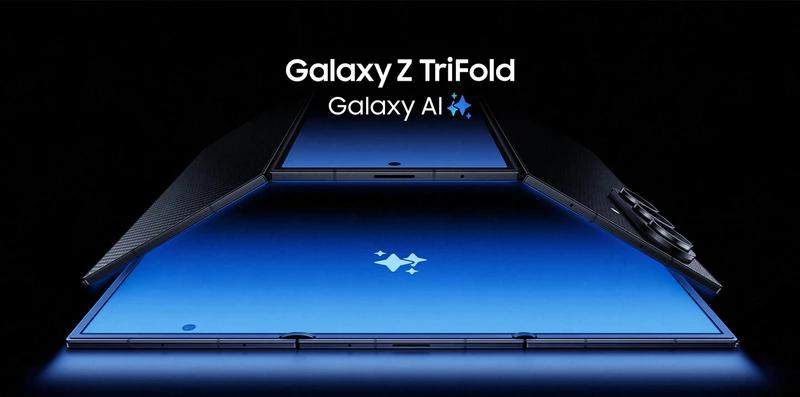
Samsung just dropped the Galaxy Z Trifold, and it's easily the most ambitious smartphone the company has ever made. This isn't just another incremental update to the Fold series—it's a completely different beast that unfolds twice to give you a legitimate 10-inch tablet that fits in your pocket.
After years of watching foldables struggle to justify their existence beyond the "cool factor," Samsung might have finally cracked the code. Here's why this tri-fold smartphone is turning heads.
What Makes the Samsung Galaxy Z Trifold Different
The Galaxy Z Trifold takes a fundamentally different approach than its predecessor, the Galaxy Z Fold 7. While traditional foldables open once to reveal a square-ish 8-inch screen, the Trifold unfolds twice, transforming into a massive 10-inch display with a 16:10 widescreen aspect ratio.
That aspect ratio is the secret sauce. We're all used to watching videos on our phones with thick black bars above and below the action. On the Trifold, full-screen videos actually fill the screen. Games get way more breathing room. Split-screen multitasking suddenly doesn't feel cramped.
Samsung's Tri-Fold vs Huawei's Approach
Samsung isn't the first to market with a trifold phone—that honor belongs to Huawei with the Mate XT, which launched in September 2024. But Samsung made a crucial design decision that could pay off: it folds inward in a U-shape.
Huawei's Mate XT folds outward like the letter Z, which means the delicate foldable screen is always partially exposed to the elements. Samsung's inward-folding design keeps the main display protected when closed, with a separate 6.5-inch cover screen handling everyday tasks.
The trade-off? You can't use the Trifold in a partial "dual-screen" mode like you can with the Mate XT. Samsung's approach is all-or-nothing: either you're using the cover screen, or you're opening the whole thing up to that glorious 10-inch canvas.
Samsung Galaxy Z Trifold Specs: What's Under the Hood
Here's what Samsung packed into this engineering marvel:
Display:
Main screen: 10-inch Dynamic AMOLED 2X, 2160 x 1584 pixels, 120Hz, 1600 nits peak brightness
Cover screen: 6.5-inch Dynamic AMOLED 2X, FHD+, 120Hz, 2600 nits peak brightness
Performance:
Processor: Snapdragon 8 Elite for Galaxy (3nm)
RAM: 16GB LPDDR5X
Storage: 512GB or 1TB (no microSD expansion)
Operating System: Android 16 with One UI 8
Camera System:
Main: 200MP wide-angle (f/1.7, OIS)
Ultra-wide: 12MP (f/2.2, 120° FOV)
Telephoto: 10MP (f/2.4, 3x optical zoom, OIS)
Front cameras: Two 10MP sensors (cover screen and main display)
Battery & Charging:
Capacity: 5,600mAh (three-cell system)
Wired charging: 45W (charger included)
Wireless charging: 15W Fast Wireless Charging 2.0
Wireless PowerShare supported
Build & Durability:
Thickness: 3.9mm at thinnest point when unfolded, 12.9mm when folded
Weight: 309g
IP48 dust and water resistance
Gorilla Glass Ceramic 2 on cover screen
Titanium hinge housing
Advanced Armor Aluminum frame
Galaxy Z Trifold Price and Release Date
Samsung launched the Galaxy Z Trifold in South Korea on December 12, 2025, priced at 3,594,000 won (approximately $2,450-$2,500 USD). That's roughly 40% more expensive than the Galaxy Z Fold 7, but significantly cheaper than the Huawei Mate XT's €3,500 price tag.
The phone comes in a single color: Crafted Black. Samsung is positioning this as a premium, limited-volume device rather than a mass-market product.
Global Availability
After the Korean launch, the Galaxy Z Trifold is rolling out to:
China, Taiwan, Singapore, and UAE: December 2025
United States: Q1 2026 (January-March)
Europe and other markets: TBA
US pricing hasn't been officially confirmed, but expect it to land around the $2,500 mark, with the 1TB variant adding another $200-$300.
What Actually Works About This Foldable Phone
The Screen Makes All the Difference
The 10-inch display with its 16:10 aspect ratio transforms how you use a phone. YouTube becomes genuinely enjoyable with the tablet layout showing comments and related videos alongside a sizable video player. Web browsing feels expansive rather than cramped. Full-screen games get real estate that makes mobile gaming feel less...mobile.
Samsung optimized the software, too. The Files app displays multiple columns so you can navigate three layers deep simultaneously. Social media apps work brilliantly in both portrait and landscape. And when you split the screen three ways, each app still has room to breathe.
Standalone Samsung DeX Changes Everything
The Galaxy Z Trifold is the only Samsung phone that runs Samsung DeX natively—no external monitor required. Connect a Bluetooth keyboard and mouse, and you've got a legitimate portable workstation with up to four separate workspaces, each running five apps simultaneously.
When you do connect an external monitor, the Trifold can act as a second screen, giving you a dual-display setup on the go. For road warriors and digital nomads, this is a game-changer.
Thoughtful Engineering Details
Samsung clearly iterated on this design extensively. The bottom panel extends slightly beyond the other two, creating a natural lip for opening the device. The magnets holding it closed have just the right strength—secure enough to stay shut, but not so strong you're fighting to open it.
The left hinge springs open automatically once you pull the lip, making the unfolding motion smooth and satisfying. There's even an auto-alarm that vibrates and displays a warning if you try to fold it incorrectly (right panel first instead of left).
The Drawbacks of Samsung's Tri-Fold Design
Durability Concerns
This is essentially a first-generation device with a display that folds twice in different directions with different radii. You can see two creases when looking for them, and the left crease is tighter than the right. Samsung includes a 50% discount on one display repair with purchase, which tells you everything about their confidence in long-term durability.
The main screen also maxes out at 1,600 nits of brightness compared to 2,600 nits on the cover display, limiting outdoor usability.
Size and Weight When Closed
At 12.9mm thick and 309g, the Trifold is chunky when closed. It's thicker than any modern flagship phone and definitely feels more substantial in your pocket. Samsung argues it's actually thinner than the first five generations of Z Fold phones, but that's cold comfort when you're used to sleek modern smartphones.
Limited Configuration
Unlike the Huawei Mate XT, you can't use the Samsung Galaxy Z Trifold in a partial dual-screen mode. It's either fully closed or fully open. The inward-folding design protects the display but sacrifices versatility.
Battery Life Questions
The 5,600mAh battery is the largest Samsung has ever put in a foldable, but it's split across three separate cells and needs to power a 10-inch display. That's small compared to typical 10-inch tablets with 8,000mAh batteries. Real-world battery life remains to be seen, though 45W charging should help.
Should You Buy the Samsung Galaxy Z Trifold?
At $2,500, the Galaxy Z Trifold is unquestionably expensive. But for the right person, it could justify that price tag.
You should consider the Trifold if:
You regularly wish you had a tablet with you, but don't want to carry two devices
You do serious multitasking on your phone and would benefit from Samsung DeX
You're comfortable being an early adopter of cutting-edge tech
You consume lots of media on your phone and want that widescreen experience
You need a portable workstation for productivity on the go
Skip the Trifold if:
You prioritize camera quality above all else (the system is good but not best-in-class)
You need the longest battery life possible
You want a slim, lightweight phone
You're not comfortable with potential durability issues on first-gen tech
You need dual-screen flexibility rather than all-or-nothing unfolding
The Future of Foldable Smartphones
Samsung's entry into the tri-fold market validates the form factor. When a company as conservative as Samsung commits to something this radical, it signals genuine potential.
The competition is heating up. Huawei shipped approximately 470,000 Mate XT units through Q2 2025, generating over $1.3 billion in revenue. That's proof there's real demand for tri-fold smartphones despite the premium pricing.
As production scales and engineering improves, expect second-generation devices with better durability, improved battery life, and possibly even stylus support (something Huawei's Mate XTs already offers). Prices should gradually come down as the technology matures.
Final Thoughts on the Galaxy Z Trifold
The Samsung Galaxy Z Trifold is exactly what it needs to be: a statement piece that pushes the boundaries of what smartphones can do. It's not for everyone, and it doesn't need to be. This is Samsung throwing ideas at the wall to see what sticks—the same company that plays it safe with the Galaxy S series is going wild with foldables.
If you've been waiting for a foldable phone that actually justifies its existence beyond novelty, the Trifold makes a compelling case. That 10-inch widescreen display transforms how you consume content, multitask, and work on the go. Yes, it's expensive. Yes, there are trade-offs. But for the first time, a foldable phone feels less like a gimmick and more like a glimpse of the future.
The Galaxy Z Trifold launches in Korea on December 12, 2025, with US availability following in Q1 2026. If you're interested, hit up a Samsung store when it arrives—this is definitely a device you'll want to try before you buy.