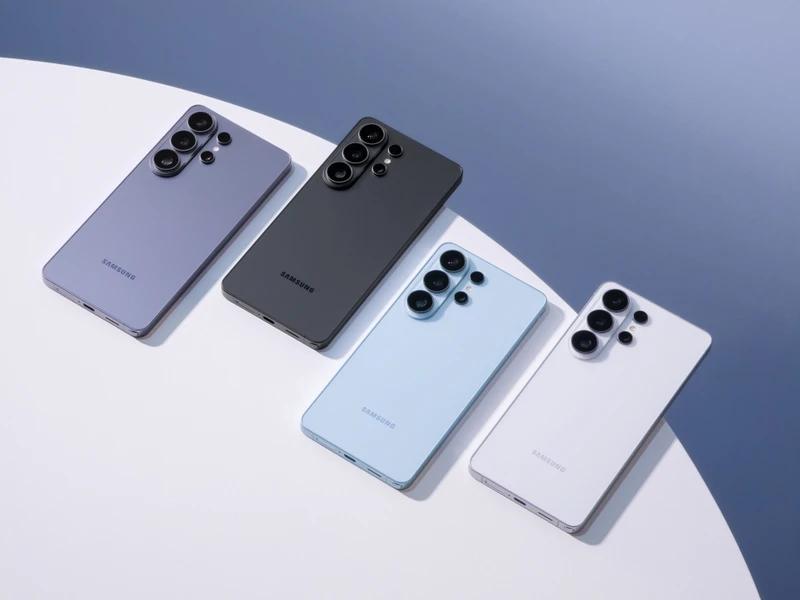
The first thing you notice about the Samsung Galaxy S26 lineup isn't the screen or the camera. It's the receipt. The base S26 starts at $900, up from $799 last year. The S26 Plus is $1,100. The Ultra holds at $1,300. You get 256GB across the board now instead of 128GB on the entry model, so the jump isn't pure markup—but it's a real one. Samsung is making room for something. Probably a Fan Edition later in the year that lands around $800 and lets the company say the "real" flagship starts here.
So the question isn't whether the S26 is good. It's whether "good" is enough when the price has crept up and the changes are mostly under the skin. Early hands-on coverage from reviewers who've spent time with the phones paints a consistent picture: the Ultra is a quiet refresh with one genuinely new trick. The base and Plus get the same chip and faster charging, but no headline feature to hang a poster on. If you're the kind of person who reads a review before buying, you already know that feeling. Satisfied, but not exactly excited.
Design: thinner, lighter, and finally in sync
Put the S26 Ultra next to the S25 Ultra and the differences are small until you pick it up. Softer corners. Sides that curve into the screen a little more gently. Samsung shaved thickness from 8.2mm to 7.9mm—the thinnest Ultra ever—and trimmed the S Pen to match. The phone is lighter too. Some of that comes from swapping titanium for aluminum, a move that echoes what Apple did with the iPhone 16 Pro: same marketing pivot from "premium material" to "we're optimizing elsewhere." Aluminum conducts heat better, which helps thermals. In the hand, the outcome is a phone that feels less like a brick and more like something you can actually hold for an hour.
For the first time since the Ultra became its own thing, the whole S26 lineup shares one design language. Same curvature, same camera housing style, same color palette. That consistency is a win if you've ever compared an Ultra to a base S and wondered why they looked like they came from different teams. The trade-off is the palette itself. Samsung has a history of bold colors. The aluminum frame is easy to anodize. And yet the options are still safe, muted, grayscale-adjacent. Nobody's asking for neon green on a $1,300 phone, but one confident color wouldn't hurt.
The privacy display: the one thing that's actually new
The only feature that feels like a real swing is on the Ultra, and it's the privacy display. You know those matte screen protectors that narrow the viewing angle so nobody can peek at your texts? They work, but they look bad and they're always on. Samsung built something similar into the panel itself. The S26 Ultra uses two types of pixels: standard ones that throw light in a wide cone, and narrow ones that focus it straight ahead. Flip the privacy mode on and the phone turns off the wide-firing pixels. From straight on, the screen looks normal. From the side—or over your shoulder—it fades to gray, then almost black. No film, no protector. Just software and hardware working together.
You can tie it to specific apps (messaging, banking, photos), to certain locations, or even to parts of the screen. Password field only. Notification strip only. That granularity is the point: privacy when you need it, a normal display the rest of the time. It's the kind of display-led experiment Samsung has tried before—curved edges, foldables, the Note—and it's the most interesting thing in the S26 lineup.
There's a catch. Turning off half the pixels cuts effective resolution and brightness when privacy is on. And in early testing, some reviewers noticed that even with privacy mode off, the S26 Ultra's viewing angles looked worse than the S25 Ultra's: more blue tint, faster brightness falloff as you tilt the phone. The same narrow pixels that enable the privacy trick don't contribute much when you're not head-on. So the privacy display isn't a free upgrade. It's a trade-off. For anyone who's wanted a built-in way to hide the screen on a train or in a queue, it's compelling. For everyone else, it's worth trying in a store before you assume it's a net win.
When you are looking straight on, the Ultra's panel is a step up. It's Samsung's first 10-bit display on a Galaxy phone, so you get a wider color range. ProScaler—Samsung's image-enhancement layer—does visible work too: in side-by-side video with the S25 Ultra, detail and sharpening are clearer on the S26. So the display story isn't just privacy. It's better color and smarter upscaling, with a viewing-angle trade-off that may or may not matter to you.
Cameras: same sensors, smarter processing
On paper the S26 Ultra's cameras look like last year's. Same 200MP main, same telephoto stack. Samsung didn't swap sensors. It widened apertures—from f/1.7 to f/1.4 on the main, f/3.4 to f/2.4 on the 3x telephoto—so more light reaches the same silicon. In low light, the combination of those wider apertures and updated noise-reduction software (which anticipates common noise patterns and cleans them before they're baked in) produces noticeably brighter, cleaner shots. It's one of those "same hardware, better result" moves that actually shows up in real use.
Video gets a useful upgrade too. Super Steady mode now has a horizontal lock that continuously measures how you're rotating the phone and removes that rotation from the frame. Pair that with the existing stabilization and you get footage that looks like it was shot on a gimbal. For vlogs or quick clips, it's a meaningful step up. Autoframing now captures in 4K instead of 1080p, and Samsung swapped lens elements to cut flare from bright sources. The Ultra is also the first Samsung phone to support APV, a high-quality video format that holds up better through multiple edits—niche for most people, but there if you need it.
Where the S26 cameras really lean in is people. Portrait and selfie processing make your face brighter, add a subtle catchlight in the eyes, and pull out more detail without cranking resolution. Bright spots like a sweaty forehead are reined in instead of blowing out. Skin texture is smoothed in a way that doesn't scream "beauty filter." Early side-by-sides with the S25 Ultra show a clear difference: the S26 makes you look a bit more polished without looking fake. Are these improvements enough to put Samsung at the very top of the smartphone camera ladder? No. But they're solid, and they're the kind of refinements that matter every day.
Performance and battery: no surprises, one complaint
Every S26 runs the Snapdragon 8 Elite Gen 5 for Galaxy. Same chip across the lineup, with Samsung-specific tuning and NPU emphasis for the AI features. It's roughly 20% faster than last year's silicon in benchmarks, and the non-Galaxy version has already proven itself in other flagships. You get 12GB or 16GB of RAM on the Ultra; the base and Plus are in the same ballpark. Nothing here will hold you back.
Charging is faster across the board: 25W on the base S26, 45W on the Plus, 60W on the Ultra. On the Ultra, 30 minutes at the plug gets you from zero to about 75%. Wireless tops out at 25W, which is a real improvement. What's still missing is magnets. No MagSafe-style ring, no built-in alignment for wireless chargers or accessories. If you want reliable wireless charging without hunting for the sweet spot, you're still looking at a case with magnets or a dock that holds the phone in place. In 2026, that feels like an omission.
Battery capacity on the Ultra is unchanged: 5,000mAh, same as the last five Ultras. Competitors in China have been shipping 7,000mAh-class phones. Samsung chose to make the S26 Ultra thinner instead of giving it a bigger cell. You get a full day for most people; heavy users will still top up. It's fine. It's just not the "we're going bigger" story some were hoping for.