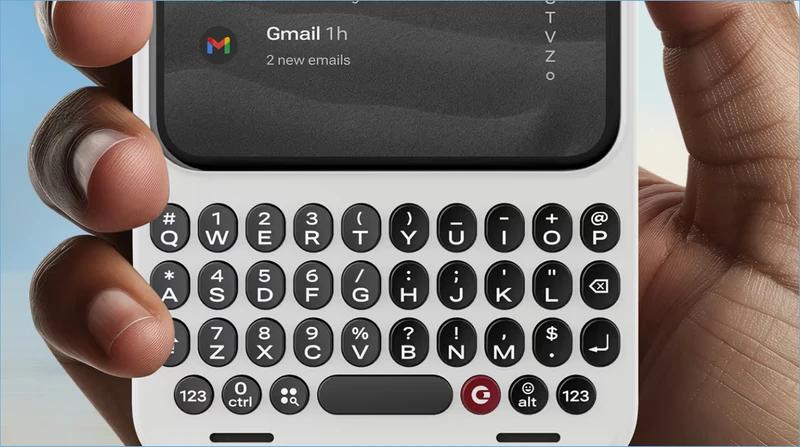
The smartphone industry has spent the last 15 years moving away from physical keyboards. Every major manufacturer abandoned the QWERTY layout in favor of all-screen designs. Touchscreens won. Physical keyboards became a relic of the BlackBerry era.
But Clicks Technology thinks there is still room for buttons. The company, which made its name with keyboard cases for iPhones, is now building its own smartphone. The Clicks Communicator is a purpose-built device designed around a physical keyboard. It is not trying to replace your iPhone or Galaxy. Instead, it wants to be your second phone, the one you reach for when you need to communicate without the distractions of modern smartphones.
The question is whether nostalgia translates to modern-day functionality. Can a physical keyboard phone find a place in 2026, or is this a product that appeals to a small group of enthusiasts who miss their BlackBerrys?
Design: Familiar, But Modern
The Communicator looks like what a BlackBerry would be if it were designed today. It has a compact, squarish form factor that measures 130.5 by 78.63 by 12 millimeters and weighs 170 grams. The device feels substantial in hand without being bulky. The aluminum frame and interchangeable back covers give it a premium feel that goes beyond what you might expect from a niche device.
The 4.03-inch AMOLED display sits above the physical keyboard. This is not a phone for watching videos or scrolling through social media feeds. The screen is sized to limit passive consumption while still supporting essential interactions. The resolution of 1080 by 1200 pixels is sharp enough for text and basic media, but the real focus here is on the keyboard below.
The keyboard itself is the star of the show. The keys are over 30 percent larger than those on Clicks' keyboard cases and bigger than some of the best BlackBerrys. The buttons have been carefully designed for ergonomics, with sculpted key surfaces and tactile feedback. Even the font has been considered. This is not just a keyboard slapped onto a phone. It is a keyboard that has been engineered for typing.
One of the more interesting features is that the keyboard is touch-sensitive. You can swipe across the keys to scroll through your inbox, messages, or web pages without your finger obscuring the screen. This is a clever solution to a problem that physical keyboards have always had. You can navigate without constantly switching between the keyboard and the touchscreen.
Clicks Communicator Display
Software: Built for Communication, Not Consumption
The Communicator runs Android 16, which means you have access to the full Android app ecosystem. But Clicks has not just slapped stock Android on here. The company has partnered with Niagara Launcher to create a custom interface that is optimized for communication.
The Message Hub is the centerpiece of this experience. When you unlock the phone using the fingerprint sensor built into the spacebar, you do not see an app grid. Instead, you see a curated view of messages across all your apps. The idea is to help you triage what needs your attention without getting lost in notifications.
As Engadget's hands-on report notes, Clicks co-founder Jeff Gadway explained that "complementary devices in tech are on the rise. You wear an Oura Ring and you wear a smart watch; you carry an e-reader for reading and a tablet for content consumption. So why shouldn't your second phone be better at certain things than your first phone instead of just being a straight duplicate?"
The Signal LED built into the side key is another thoughtful touch. It can be configured to show different colors for different apps or contacts, giving you context about what needs your attention without even picking up the phone. If you need to focus, there is a physical kill switch to turn everything off.
The Prompt Key is a dedicated button for voice input. Hold it down while in a text field, and it starts speech-to-text. Release it, and your message is sent. It can also be configured to record voice notes or start conversations with virtual assistants. This is about giving you the right input method for the task at hand.
Performance: Enough Power for the Job
The Communicator is powered by a MediaTek 4-nanometer 5G IoT SoC with 8GB of RAM. This is not flagship-level performance, but it does not need to be. The device is not designed for gaming or intensive multitasking. It is designed for communication, messaging, and light productivity tasks.
The 256GB of internal storage is expandable up to 2TB via microSD card, which is a feature that has largely disappeared from modern smartphones. The Communicator also includes a 3.5mm headphone jack, another feature that most manufacturers have abandoned. These choices signal that Clicks is listening to what people actually want, not just following industry trends.
Clicks Communicator Performance
The device supports 5G connectivity, which means it can handle modern network speeds. It also includes both a physical SIM slot and eSIM support, giving you flexibility in how you connect. Wi-Fi 6 support, Bluetooth, and NFC are all included. This is a fully modern smartphone in terms of connectivity, even if the form factor feels retro.
Cameras: Functional, Not Flagship
The Communicator includes a 50-megapixel rear camera with optical image stabilization and a 24-megapixel front-facing camera. These are not flagship-level cameras, but they do not need to be. The Communicator is not designed for photography. It is designed for communication.
The cameras are there for video calls, quick documentation, and the occasional photo. They are functional, which is all they need to be. If you want to take serious photos, you are probably reaching for your main phone anyway.
Clicks Communicator Cameras
Battery: All-Day Power with Modern Charging
The Communicator includes a 4,000mAh silicon-carbon battery. This is not the largest battery on the market, but it should be enough for a device that is not designed for heavy media consumption. The silicon-carbon technology should also help with long-term battery health, which is important for a device that some people might keep for years.
Charging is handled via USB-C for wired charging and Qi2 wireless charging for convenience. The Qi2 standard means it is compatible with MagSafe accessories, which is a nice touch for iPhone users who might be considering this as a second device.
Clicks Communicator Battery
The Typing Experience: The Real Test
The physical keyboard is what makes or breaks this device. Based on the specifications and design details, the keyboard should be comfortable for extended typing sessions. The larger keys, sculpted surfaces, and tactile feedback are all designed to make typing feel natural.
The touch-sensitive keyboard feature is particularly interesting. Being able to scroll through messages and lists without switching to the touchscreen could make the device more efficient for communication tasks. But this is something that will need to be tested in real-world use to see if it actually improves the experience or if it feels gimmicky.
For people who have never used a physical keyboard on a phone, there will be a learning curve. Touchscreen typing has become second nature for most people. Switching to physical keys requires retraining your muscle memory. But for people who miss their BlackBerrys or who prefer physical keyboards, this could be exactly what they have been waiting for.
Software Support: A Concern
The Communicator ships with Android 16 and promises two years of OS updates and five years of security updates. This is not the seven-year commitment that Samsung and Google are offering, but it is reasonable for a smaller manufacturer. The question is whether two years of OS updates is enough for a device that costs $399 to $499.
If you are buying this as a second phone that you plan to use for several years, the update commitment might be a concern. But if you are treating it as a specialized tool that you use alongside your main phone, two years of OS updates might be sufficient.
The Value Proposition: Who Is This For?
The Communicator is available for early reservation at $399, with a full retail price of $499. This puts it in the same price range as mid-range smartphones like the Pixel 9a. But the Communicator is not trying to compete with those devices. It is trying to be something different.
As FoneArena's coverage notes, the device is positioned as a "communication companion" designed for "doing, not doomscrolling." This is a device for people who want to separate their communication device from their content consumption device.
The target audience is clear. People who carry two phones already. People who want more separation between work and personal life. People who miss physical keyboards. People who want a device that is optimized for communication rather than consumption.
But the question remains: Is there enough of an audience to make this viable? Clicks does not need to sell millions of these. As Gadway told Engadget, "The good thing about being a smaller hardware maker is that Clicks doesn't need to sell millions of these — they're just interested in offering an alternative for people who might enjoy it."
The Bottom Line
The Clicks Communicator is a fascinating experiment in what a smartphone can be when it is not trying to be everything to everyone. It is purpose-built for communication, and every design decision reflects that focus. The physical keyboard, the Message Hub, the Signal LED, and the compact form factor all work together to create a device that is optimized for a specific use case.
But is it practical? That depends on what you need. If you are someone who carries two phones, misses physical keyboards, or wants a device that helps you focus on communication rather than consumption, the Communicator could be exactly what you are looking for.
The $399 to $499 price tag is reasonable for what you are getting, but it is still a significant investment for a second phone. The two-year OS update commitment might be a concern for people who plan to use the device long-term, but for a specialized companion device, it might be sufficient.
What is clear is that Clicks has thought carefully about who this device is for and what it should do. The Communicator is not trying to replace your main phone. It is trying to complement it. Whether that is enough to justify the price and the form factor is something that each potential buyer will need to decide for themselves.
The Communicator will not be for everyone. But for the people it is for, it might be exactly what they have been waiting for. The device is expected to ship later in 2026, and we will have to wait and see if it finds its audience. But one thing is certain: In a world of increasingly similar smartphones, it is refreshing to see a company try something different.