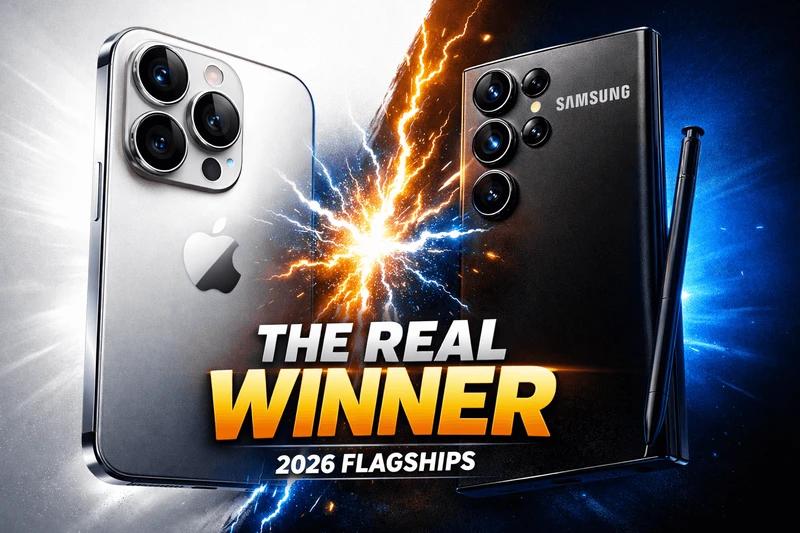
Apple brought a vapor chamber to a titanium fight. That's the quickest way to describe the iPhone 17 Pro Max vs Samsung S25 Ultra showdown — two radically different philosophies of what a $1,200 phone should be, from two companies that have never agreed less about how to get there.
The iPhone 17 Pro Max costs $1,199. The Galaxy S25 Ultra costs $1,299. That $100 gap is the smallest financial distance between Apple's and Samsung's top-tier flagships in years, and it makes the choice feel almost uncomfortably direct. You're not picking a price tier anymore. You're picking a worldview.
Device ID: 346348fa-b2e9-491a-8ce9-512acd01b584
These two phones exist in a market that's shifting under everyone's feet. The flagship phone comparison of 2026 isn't about megahertz or megapixels — it's about AI platforms, ecosystem gravity, and which company's vision of an "intelligent phone" actually delivers when you need it to. Apple Intelligence arrived with iOS 26, positioning Siri as a genuine on-device reasoning engine for the first time. Samsung's Galaxy AI, powered by Gemini, has had nearly a year to mature since the S25 Ultra's January 2025 launch. Both companies are betting your next phone needs to think, not just compute.
Device ID: e77512bd-c650-4760-827a-f3f8bad4a834
iPhone 17 Pro Max vs S25 Ultra: two different hardware philosophies
Apple did something nobody expected with the iPhone 17 Pro Max: it dropped titanium. The 7000-series aerospace-grade aluminum unibody isn't a cost-cutting move — it's a thermal engineering play. That unibody design enables a vapor chamber cooling system that keeps the A19 Pro chip running at higher sustained clocks than any previous iPhone. Samsung kept titanium for the S25 Ultra, pairing it with a 40% larger vapor chamber of its own and the Snapdragon 8 Elite.
Both displays measure 6.9 inches, but the iPhone pushes 3,000 nits peak outdoor brightness against Samsung's 2,600. In direct sunlight, the gap is visible. Both run at 120Hz, both look gorgeous, and both will ruin every other screen you've ever used.
Where Samsung pulls ahead is the S Pen — Apple still hasn't offered stylus input on a phone. For the subset of users who take handwritten notes, annotate PDFs, or sketch ideas on the fly, the S25 Ultra remains the only serious option. Samsung did strip Bluetooth from the S Pen this generation, removing gesture controls that few people used but that an "Ultra" phone implicitly promised.
The real flagship phone comparison: silicon and AI
The A19 Pro benchmarks are staggering. A single-core score of 3,791 and a multi-core of 9,829 on Geekbench 6 put Apple comfortably ahead of the Snapdragon 8 Elite. The 16-core Neural Engine pushes past 35 TOPS of dedicated AI compute, and the real-world payoff is Apple Intelligence features — live transcription, on-device summarization, generative photo editing — that respond with almost zero perceptible latency.
Samsung's AI story has a different kind of advantage: maturity. Galaxy AI has had over a year in users' hands. Circle to Search remains one of the most genuinely useful AI features on any phone. The object eraser is best-in-class. Gemini integration handles compound tasks — "find the restaurant from last Tuesday and send the address to my wife" — with improving reliability.
Here's the contrarian take that might sting: neither company's AI is as transformative as the marketing suggests. Both suites are collections of useful-but-narrow features wrapped in ambitious branding. The phone that fundamentally changes how you work hasn't arrived yet. These two are laying foundations, and which foundation proves sturdier is a question that won't be answered until 2027 at the earliest.
iPhone vs Samsung cameras: consistency meets ceiling
Apple went with triple 48MP sensors across all three lenses, and this uniformity matters more than the megapixel count implies. Every lens produces images at the same baseline quality. You can crop aggressively from any of them. The 8x optical zoom at 200mm is Apple's longest reach yet, and it's remarkably sharp for a phone lens.
Samsung's 200MP main sensor remains the higher ceiling in perfect conditions — wall-poster crops from a phone sensor still feel like magic. But the 50MP ultra-wide and the telephoto system don't quite match the main sensor's quality, creating an inconsistency the iPhone avoids entirely. In blind photo tests, the iPhone 17 Pro Max edged ahead in most scenarios, with Samsung winning in extreme zoom and low-light macro.
For video, there's no contest. ProRes RAW, Apple Log 2, and 8K at 60fps make the iPhone 17 Pro Max the default tool for anyone who shoots professionally on a phone. Samsung offers 8K recording too, but the post-processing pipeline and color science simply cannot match what Apple has built with Final Cut Pro integration.
Who should buy which — and why it's personal
The iPhone 17 Pro Max vs Samsung S25 Ultra decision reduces to a question of identity, not specs. If you live in Apple's ecosystem, value camera consistency, shoot video, and want the longest battery life in any flagship — 33 hours rated, and real-world tests back that claim — the iPhone at $1,199 is the better value by nearly every objective measure.
If you want Android's flexibility, Samsung's seven-year update commitment, the S Pen, and an AI suite that's had time to prove itself in daily use, the Galaxy S25 Ultra remains the most complete Android phone ever made. The $1,299 price stings slightly more, but One UI 7 is genuinely Samsung's best software effort, and the Snapdragon 8 Elite ensures it won't feel slow for years.
Here's what's really happening beneath the spec sheets: the gap between these two phones has never been smaller, and the decision has never been more personal. The iPhone 17 Pro Max vs Samsung S25 Ultra isn't a question of which phone is objectively better — it's a question of which ecosystem you trust to build the next five years of mobile computing on your behalf. That's the $1,200 question. And no benchmark can answer it for you.
Tags:
iPhone 17 Pro Max
Samsung Galaxy S25 Ultra
flagship comparison
Apple
Samsung
A19 Pro
Snapdragon 8 Elite
2026
Share:
Frequently Asked Questions
The main difference between the iPhone 17 Pro Max and Samsung S25 Ultra is their ecosystem and design philosophy. The iPhone 17 Pro Max uses an aluminum unibody with vapor chamber cooling and Apple's A19 Pro chip running iOS 26, while the Samsung S25 Ultra features a titanium frame, Snapdragon 8 Elite processor, and includes an S Pen stylus. Apple prioritizes camera consistency and video; Samsung offers more hardware versatility.