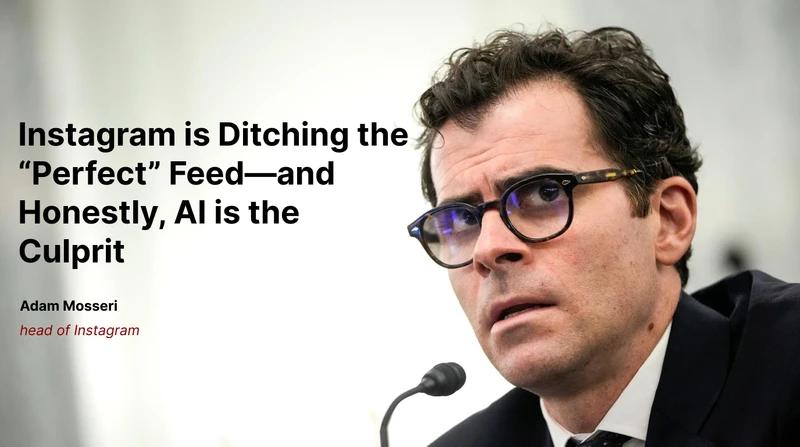
If you feel like your Instagram feed has lost its "soul" lately, you aren’t alone. In fact, the man in charge of the app actually agrees with you.
In a surprisingly vulnerable New Year’s Day 2026 essay titled "Authenticity after Abundance," Instagram Head Adam Mosseri laid out a vision for the platform that sounds less like a tech update and more like a manifesto for human survival in the age of AI. His core message? The polished, "perfect" Instagram we’ve known for a decade is dead. And AI is the one that pulled the trigger.
When "Perfect" Becomes a Commodity
For years, the "Instagram Aesthetic" was all about high-contrast landscapes, smoothed skin, and meticulously curated grids. But as Mosseri points out, we’ve hit a wall. In a world where Midjourney and Sora can generate a "flawless" human face or a cinematic sunset in seconds, perfection has become cheap.
Mosseri argues that because AI can now simulate "authentic" voices and visuals indistinguishable from reality, the bar has shifted. It’s no longer about can you create?—it’s about can you make something that only you could create?
The Rise of the "Raw Aesthetic"
One of the most interesting parts of Mosseri's update is his critique of how we use the app. He admits that the public feed—the place where we used to post our "best" square photos—is effectively a ghost town for personal sharing. Real life has moved to DMs and Stories, where the vibe is unpolished, shaky, and real.
Think shoe shots and unflattering candids," Mosseri writes. He highlights creators like @jordan_the_stallion8, who shoots videos in a simple bathroom mirror, as the new vanguard of trust. In his view, "flattering imagery" is now boring to consume. We are entering an era where imperfection is a signal of truth. If a photo is a little blurry or the lighting is "bad," it acts as a defensive shield—a way of saying, "This is real because a computer wouldn't have made it this messy.
Defaulting to Skepticism
Mosseri’s most jarring admission is that we can no longer trust our own eyes. He notes that for most of his life, a video was proof that something happened. Now? "This is clearly no longer the case."
He references Malcolm Gladwell’s Talking to Strangers, noting that humans are "genetically predisposed" to believe what they see. Overcoming that instinct will be "incredibly uncomfortable," but Mosseri insists that by 2026, we must move to a "skepticism by default" mindset. We have to stop asking what we are seeing and start asking who is sharing it and why.
The End of "Chasing Fakes"
Perhaps the biggest technical shift mentioned in reports by The-Decoder and Engadget is Meta’s pivot on AI detection.
Mosseri admits that trying to label every AI "fake" is a losing battle because AI evolves too fast. Instead, he’s pushing for "fingerprinting the real."
Cryptographic Signatures: He’s calling on camera and phone manufacturers to sign images at the moment of capture, creating a "chain of custody" that proves a photo came from a physical lens.
Account Credibility: Instagram will soon surface more "context signals"—like where an account is located and what else they’ve posted—to help you decide if they are a human you should trust.
The Bottom Line
The 2026 takeaway for creators and brands is simple but terrifying: be more human. Don't hide your flaws; lead with them. In an era of infinite synthetic abundance, the only thing that can't be mass-produced is your specific, messy, imperfect reality.
As Mosseri puts it:
"Rawness isn’t just aesthetic preference anymore—it’s proof."